

Ballad Lines at Southwark Playhouse Elephant Review
The new folk musical makes its London premiere with a multi-generational story

ballad (noun) /ˈbæl.əd/ lines (noun, plr) /laɪnz/
The word “Ballad” derives from Latin and French ballare or ballade, meaning “to dance” or “dancing song”, which are traditional, orally transmitted lyrical folk songs. These songs (tune and melody) are passed down the generations, sometimes across border lines and cultures such as the Scottish, Irish and Appalachian borders.
Song-making culture intertwines with three distinct narratives across centuries, past and present, in Finn Anderson and Tania Azevedo’s new musical, developed for its London premiere at Southwark Playhouse Elephant.
The show follows New Yorker Sarah (Frances McNamee), who eagerly turns the page on a new chapter of life with her partner Alix (Sydney Sainté), but struggles to come to terms with motherhood and the mutual commitment required of both herself and her chosen family as a queer woman in the 21st century.


In a desperate search for answers from her own past, Sarah delves into a mysterious box of tapes recorded by her aunt Betty (Rebecca Trehearn), retelling the tales of two women who came before her; their stories, set in 17th-century Scotland and 18th-century Ireland, are linked by shared experiences of motherhood and ballads passed along her bloodline, one Sarah attempts to reconciliate with along her journey of discovery – of self, of heritage and of family.
Parallel storylines are perhaps a notorious writing challenge for the stage specifically, but the creators confidently take this in their stride. The book is structured with intention, while the embedded use of both traditional and original material links the three narrative strands together in a way that is mostly easy to follow.


Anderson’s overtly rhythmic score understands a variety of Western stylistic influences. This is echoed in informed compositional choices, from modal scales characteristic of folk music to a more relaxed swing in blues, and the virtuosic scalic runs (spotlighting fiddler Sally Simpson) found in lively dances. Credit is also due to the wider music team: sound designer Andrew Johnson, arranger Daniel Jarvis, a team of orchestrators and musical director Shonagh Murray on keys, bringing the expansive score to life alongside the four-piece onstage band at each performance.
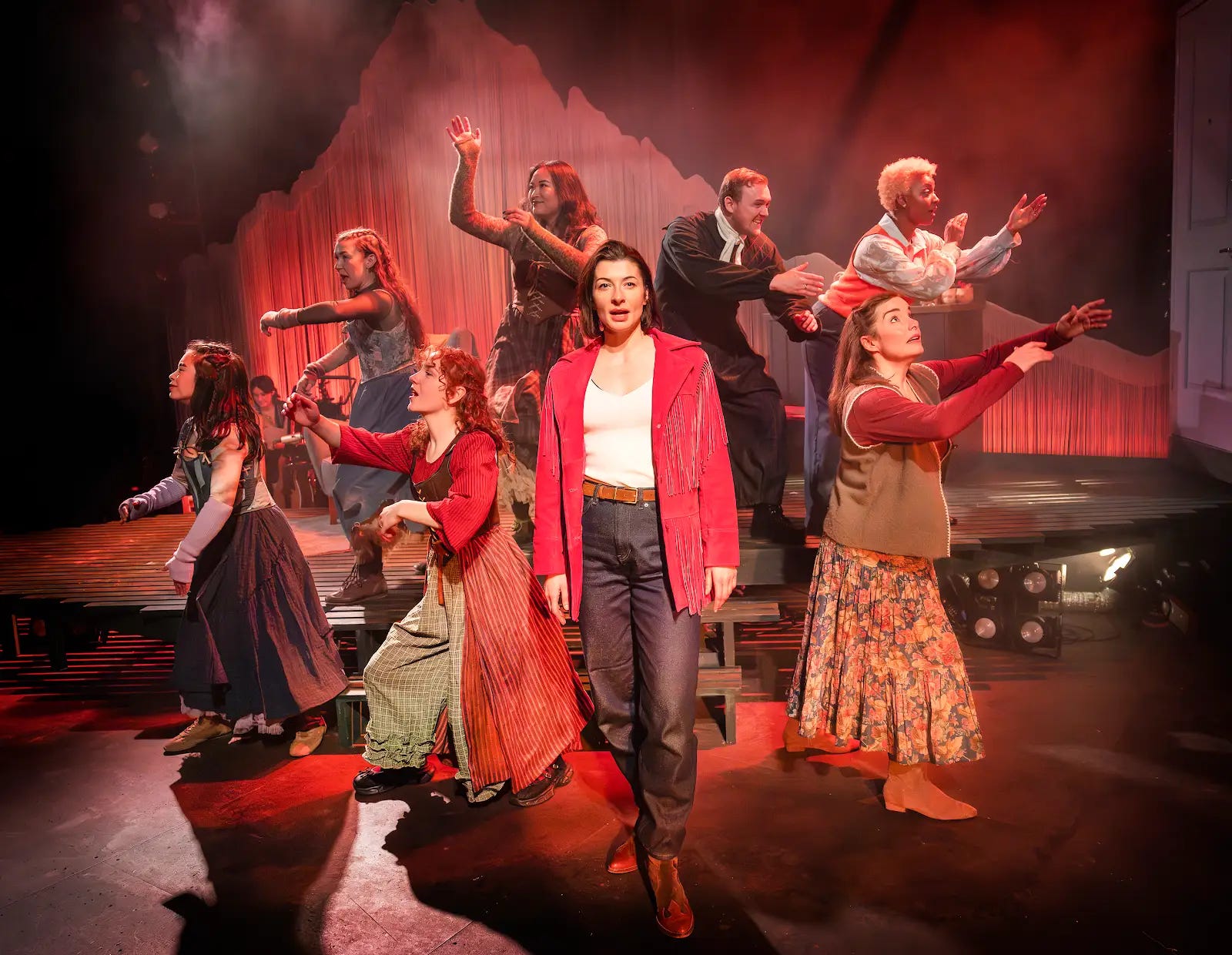
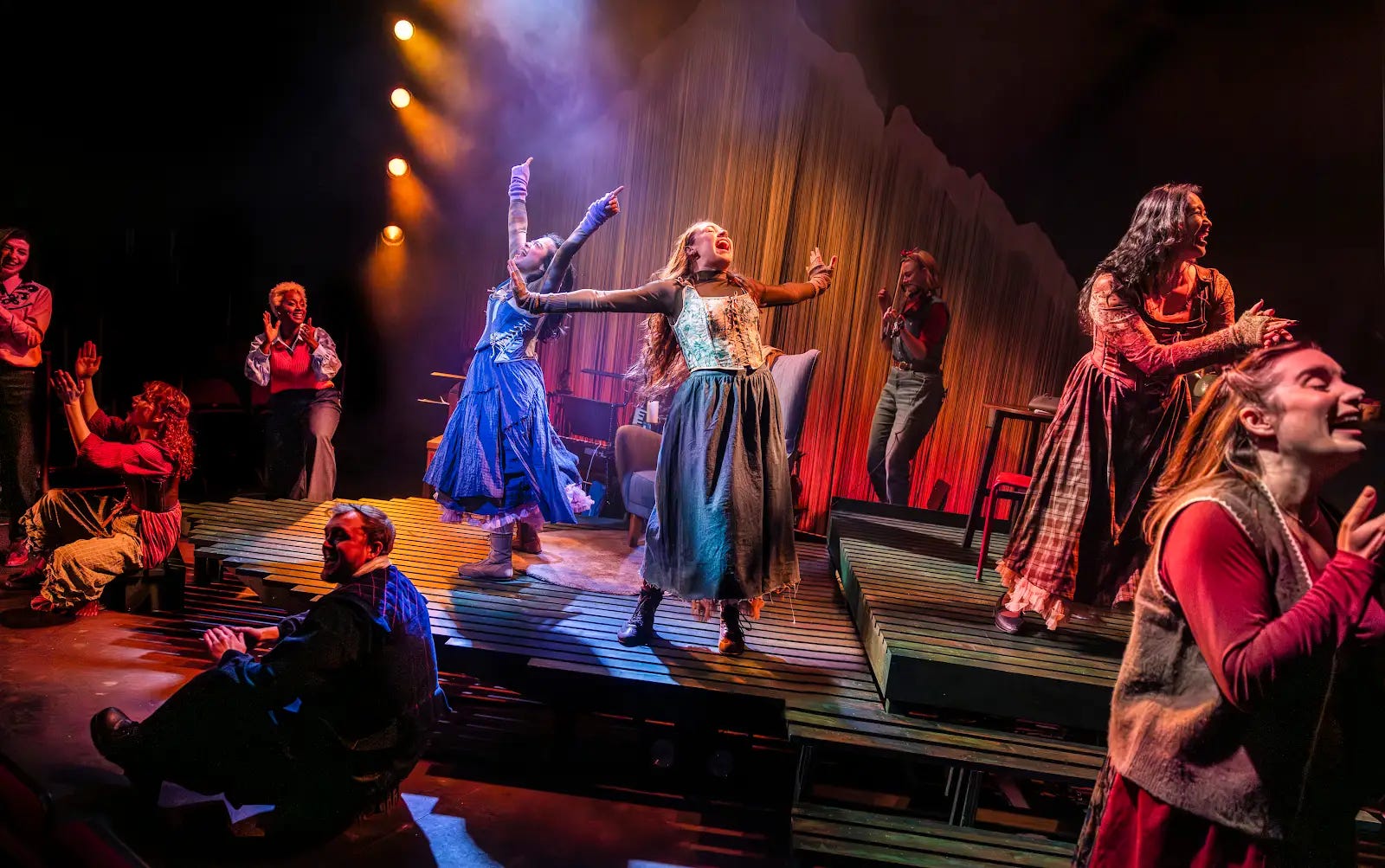
Perhaps the fact that Tania Azevedo knows the production inside out as both writer and director makes translating ideas from page to stage a much easier task. Many moments of staging effectively utilise space, proximity and levels to reach all corners of the thrust stage; TK Hay’s simple yet functional set is lit with clear visual intent by Simon Wilkinson. This level of clarity – a testament to the combined effort of direction, design and performances – creates distinct caricatures of women, whose trials and tribulations the story does not shy away from confronting.
Over at Southwark Playhouse Borough


The entire ensemble cast is excellent, particularly whenever there’s a chance for their collaborative nature – within the cast and with the onstage band – to shine through. Rebecca Trehearn opens the show as Betty, sewing the threads throughout the story with the bright, rich voice she is known to many for, including yodel-style vocal moments for good measure; Frances McNamee and Sydney Sainté’s dynamic as Sarah and Alix feels authentic of a modern couple, while Kirsty Findlay and Yna Tresvalles’ Cait and Jean provides a contrasting visual parallel of three women’s experiences across three different centuries.
Joined by Ally Kennard, Siân Louise Dowdalls and Gracie Lai, the company as one creates complex, suspended harmonies emblematic of Celtic music, matched visually by Tinovimbanashe Sibanda’s thumping, motion-driven choreography.
The themes explored within the show are ambitious in both quantity and breadth; while not all themes are fully explored nor equally weighted given their interdependency, cohesive creative choices leave little ambiguity, in a well-sewn narrative that ties up loose ends in good time. It’s somewhat refreshing to see a story that doesn’t buy into stereotypes and doesn’t necessarily conform to the ‘celebratory resolution as an ending’ model – its protagonist carries on with life, humming a memorable leitmotif with a poetic lyric or two.
★ ★ ★ ★ ☆
Ballad Lines plays at Southwark Playhouse Elephant until 21 March. For more information and to book tickets, visit the venue website.
Tickets and Accessibility
🎟️ Tickets were kindly gifted with expectation of an honest, unbiased review. Views expressed are of the writer's and do not represent those of the promoters - read our editorial policy here.
Standard tickets are available from £25, with concessions from £20. Previews were flat priced at £16 (first Pioneer Preview at £10).
♾️ The production features the use of flashing lights, haze and amplified music throughout. Visual cues for sudden changes in volume caused by starts of music can be taken from the music director, positioned upstage centre.